Outdoor BlindsAwningsKnowledge Hub
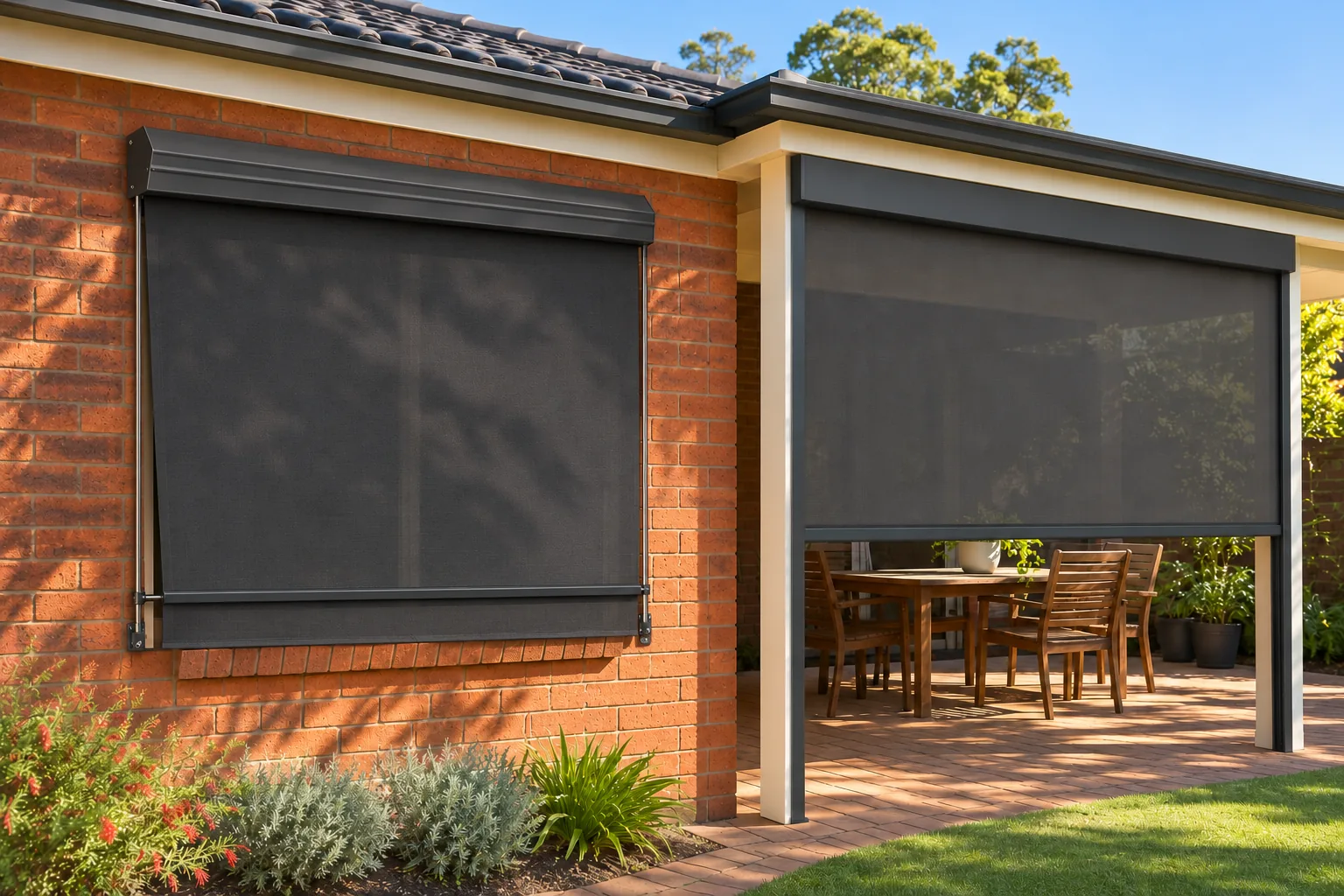
The short answer: traditionally, the difference is the angle of travel. An awning projects outward from the wall on an angle (much like an awning window that winds out at an angle), whereas a product that runs straight up and down vertically is an outdoor blind or straight-drop blind.
- Modern umbrella term: most of the Australian blind industry now uses outdoor blinds to cover all fabric outdoor shading systems—both straight-drop blinds and projecting awnings.
- Two rigid exceptions: neither aluminium roller shutters (a security and window insulation barrier) nor external aluminium plantation shutters (louvred architectural screens, often called external shutters or aluminium shutters) are fabric outdoor blinds—and they are very different products from each other.
- Fabrics now overlap: modern outdoor blinds and awnings share woven 95% or 99% mesh, translucent acrylic, traditional poly-cotton greenback canvas and 100% blockout outdoor fabrics.
If you have ever rung around for quotes and heard one company call a verandah screen a straight drop awning while another calls a window canopy an outside blind, you are not imagining the overlap. Homeowners phone us every week asking for “outside blinds”, “canvas awnings”, “cafe blinds” or “external shutters” to solve the same Adelaide western sun problem.
Knowing where the traditional terms come from—and how they line up with modern products and fabrics—makes it much easier to compare quotes and ask for the right system on site.
Traditional angle versus vertical travel
The easiest way to picture the traditional split is to look at how a house window works. An awning window is hinged at the top and winds outward at an angle from the wall, creating an angled hood that sheds sun and light rain while letting warm air escape underneath.
A traditional awning works the exact same way on the outside of your home: its fabric projects forward on metal arms so sunlight is stopped before it hits the glass, while breeze still moves behind it. By contrast, a traditional outdoor blind (or straight drop blind) hangs in one vertical plane under a verandah beam, pergola lintel or window headbox and travels straight up and down along your post line or wall.
| Product family | How it moves | Main job | Typical fabrics or material | Common examples |
|---|---|---|---|---|
| Window awnings | Projects out from the wall at an angle | Shade exposed windows while keeping breeze and window opening clearance underneath | Poly-cotton canvas (traditionally greenback), 100% blockout, acrylic, or 95%–99% woven mesh | Auto Guide awnings, Pivot Arm awnings |
| Overhead patio awnings | Extends outward overhead without front posts | Retractable overhead shade over an unroofed deck, courtyard or terrace | Solution-dyed acrylic (most common), or selected outdoor screen fabrics | Folding Arm awnings, Sundream conservatory awnings |
| Straight-drop & guided outdoor blinds | Travels straight up and down vertically | Screen the open side of a covered verandah, pergola, balcony or tall window | 95% or 99% woven mesh, clear/tinted PVC, 100% blockout, canvas or acrylic | Ziptrak®, Zipscreen, Straight Drop, Wire-Guided, Zip Roll Up |
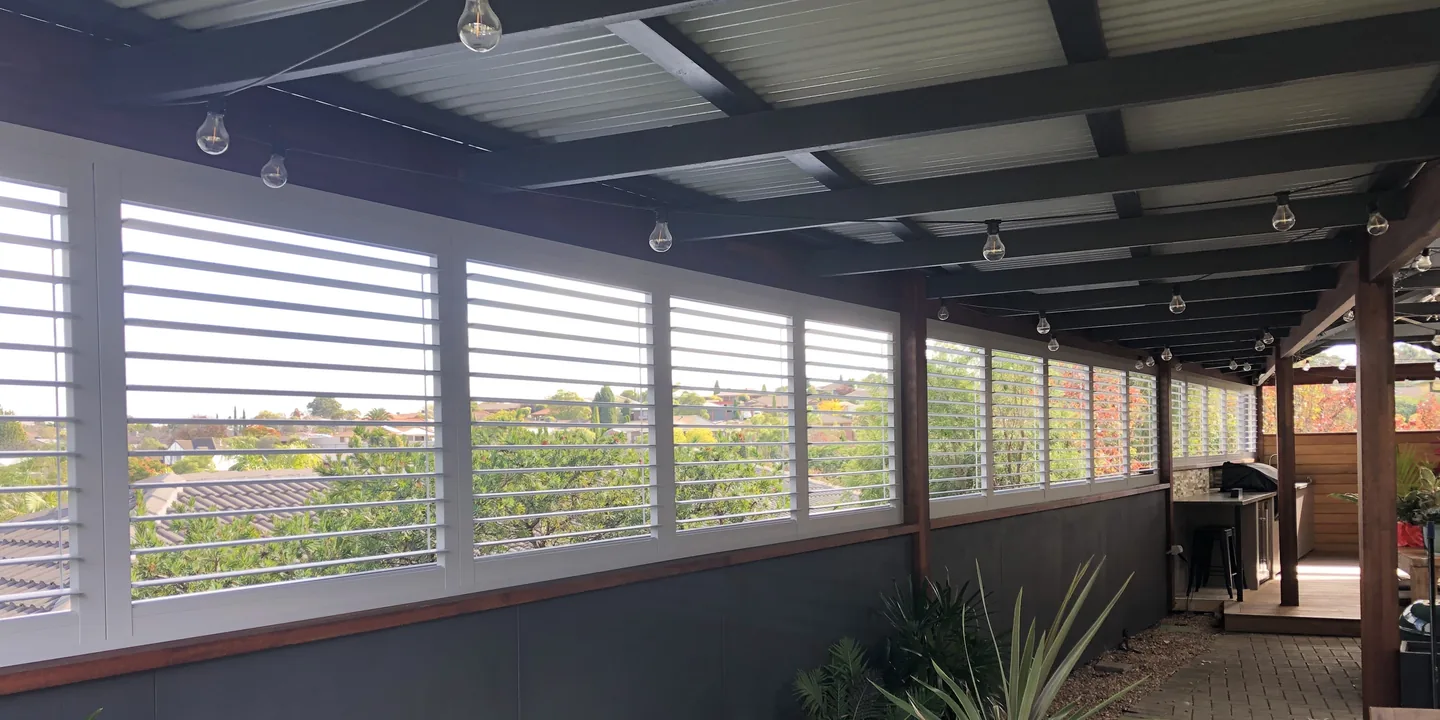
| External aluminium plantation shutters | Hinged, sliding, bi-fold or fixed rigid panels with tilting blades | Adjustable architectural privacy, airflow and filtered shade on alfrescos, balconies and windows | Powder-coated structural aluminium frames and 60, 90 or 115 mm elliptical blades | Outdoor plantation shutters (external shutters / aluminium shutters) |
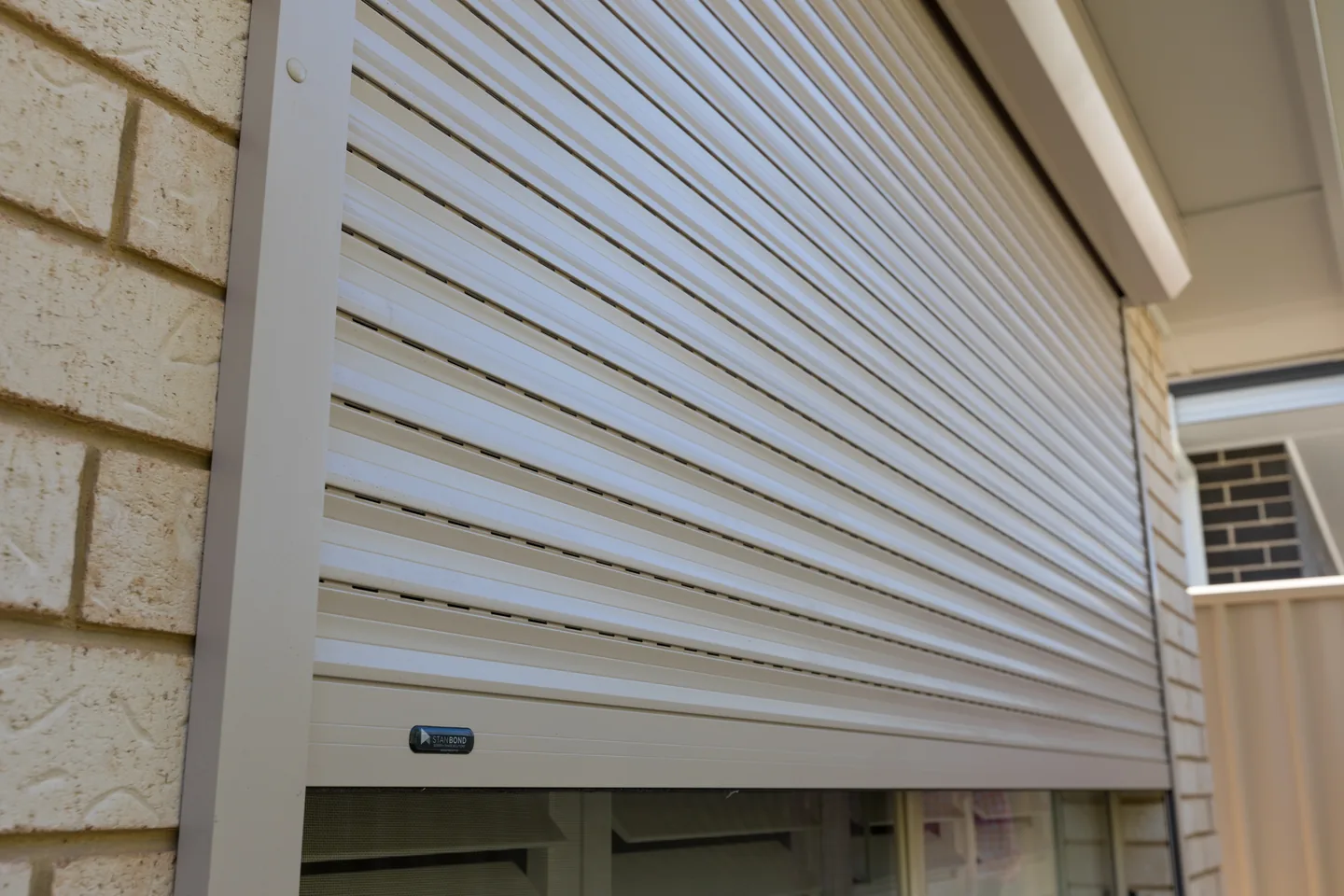
| Roller shutters | Vertical rolling slats inside side tracks into an overhead box | Security deterrence, bedroom darkening, noise dampening and window insulation | Interlocking curved, foam-filled double-walled aluminium slats | Ozroll Rollashield roller shutters |
What is an awning? (Angled out from the wall)
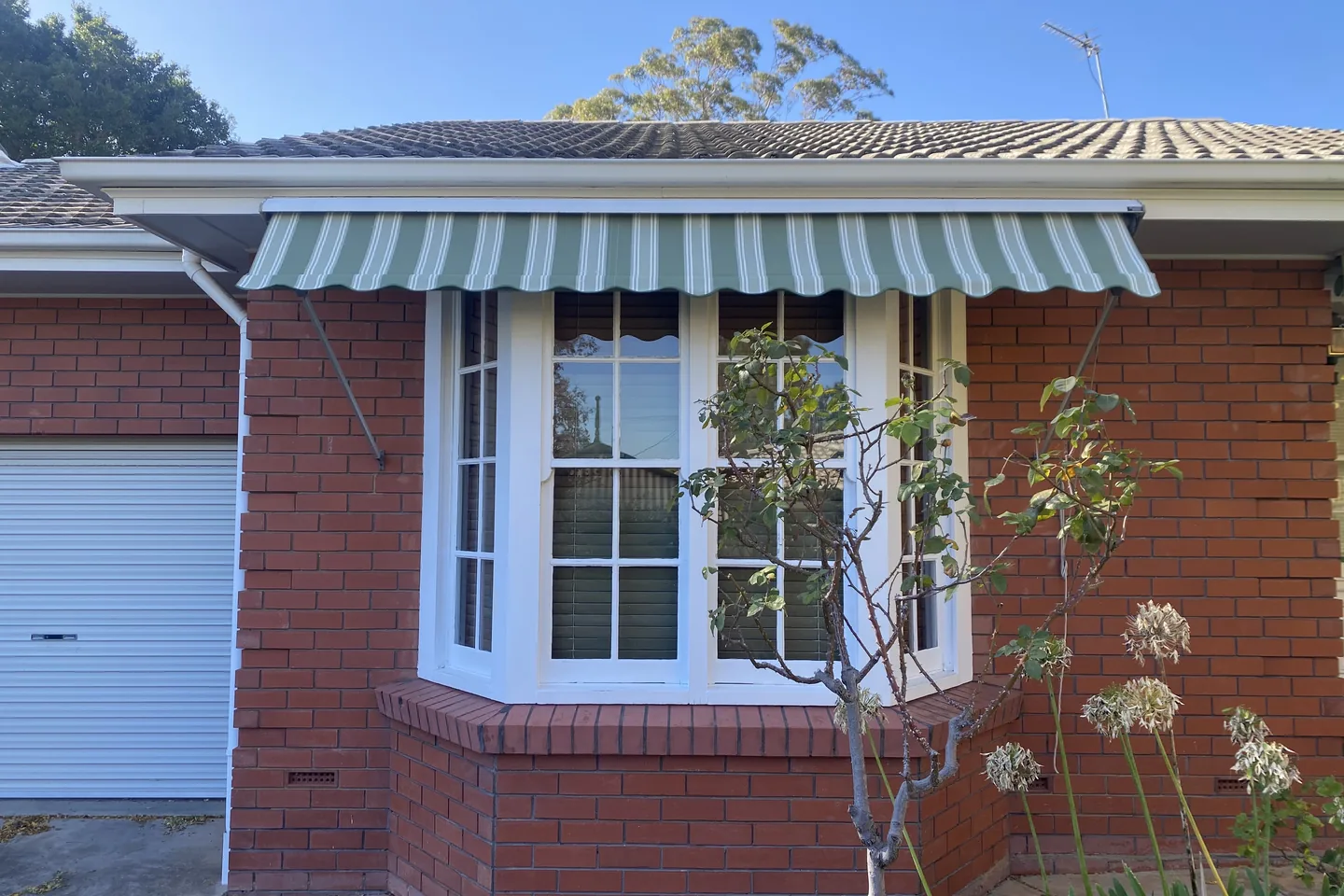
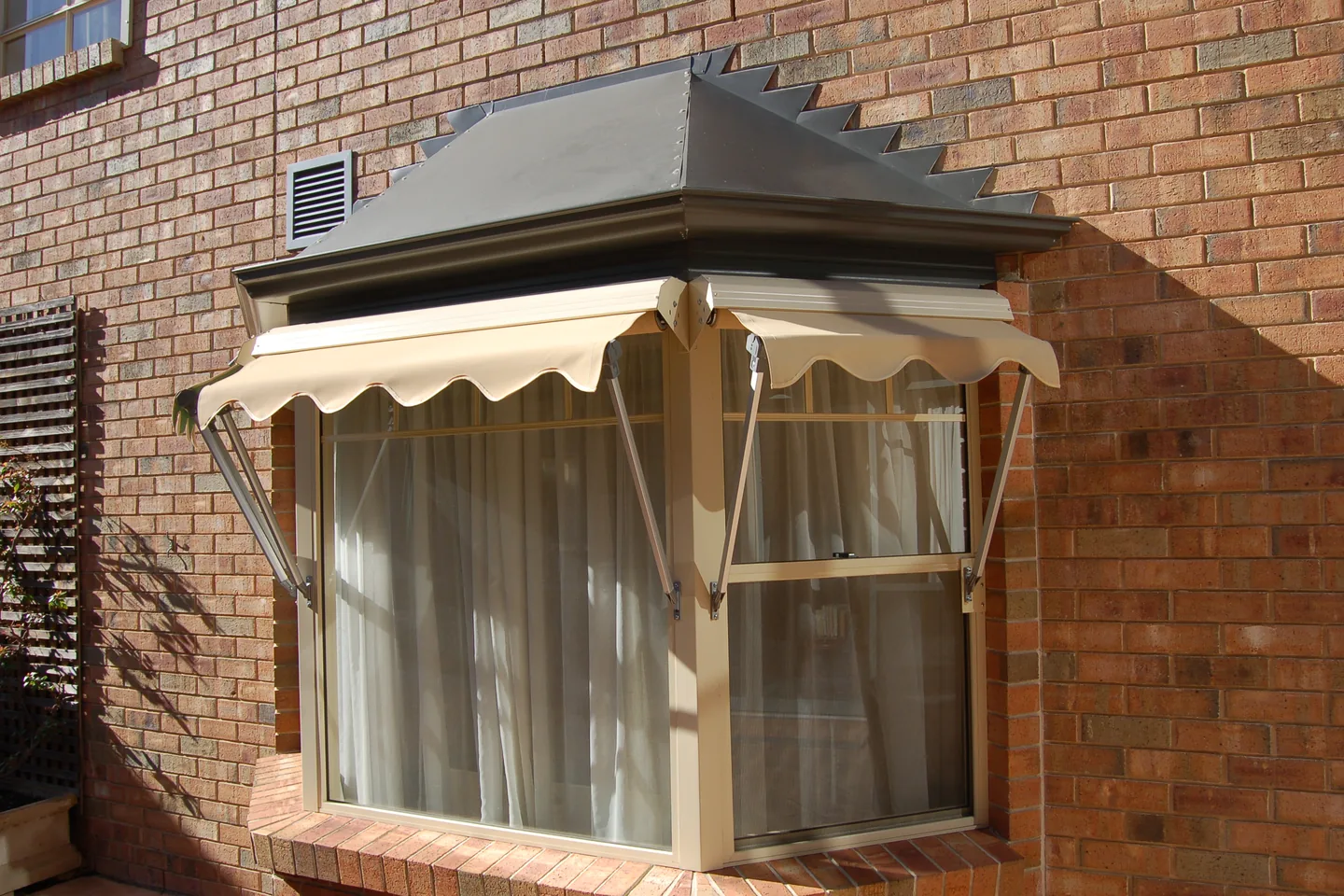
Traditionally, an awning stands clear of the building line rather than dropping straight down the face of the glass or posts. Across Adelaide homes, there are three main styles you will see quoted:
Auto Guide awnings (Automatic / Lock Arm)
An Auto Guide awning is the classic Australian ground-floor window awning. A spring inside the top aluminium roller keeps tension on the fabric sheet, which rolls out over the window on two short horizontal lock arms mounted to vertical stainless-steel or zinc-plated guide rods. Simply lifting or pulling the five-sided bottom rail—by hand or with a pull-stick—slides the lock arms up or down the rods and locks the awning at any height.
Because the cloth side edges stay free and the awning projects off the brickwork (with 150 mm, 300 mm or 450 mm standard arm projections), hot air does not get trapped against the windowpane, and outward-opening awning windows or casements can still open behind it. If your home has weatherboard or lightweight cladding where standard bottom rod brackets cannot take tension, an S2000 variant allows claw arms and movable hood brackets to line up with structural studs. Coastal Adelaide properties can specify 316-grade stainless-steel guide rods and hardware to resist salt corrosion.
Pivot Arm awnings
A Pivot Arm awning replaces the sliding lock arms and wall rods with longer side arms pivoted midway down the window frame or wall. Operating by external crank, internal cord winch or motorised drive, those arms swing the bottom rail out in a wider arc from the building.
Pivot arm awnings are especially handy when an awning needs to clear an outward-opening door, extend slightly further than a lock-arm projection, or sit above ground level where you cannot reach a guide rod by hand. Keep in mind that pivot arm awnings are lightweight sun-and-airflow products rather than heavy wind barriers—strong gusts can catch underneath and make the arms bounce or tap, so it is best to retract them before rough weather (especially outside bedroom windows).
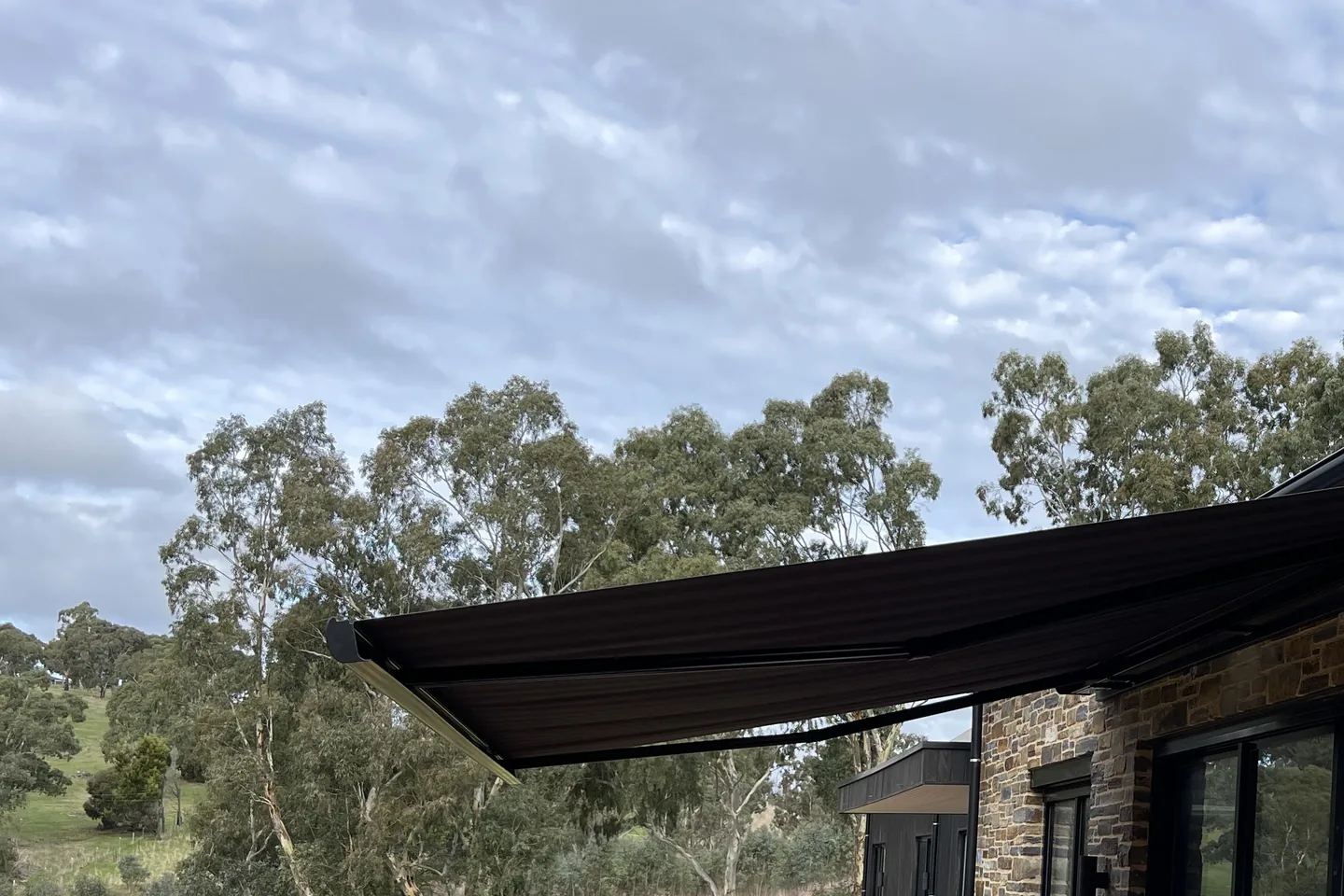
Folding Arm awnings
When a patio, courtyard or poolside deck has no overhead roof or pergola posts, a Folding Arm awning creates retractable overhead shade straight off the house wall or fascia. Strong internal spring-tensioned articulated elbows extend the canopy horizontally or on a gentle pitch (adjustable on Aluxor Stratos I open, Stratos III semi-cassette and Discus full-cassette systems), then fold back neatly into a compact profile when you want winter sunlight or open sky.
Because folding arm awnings carry significant leverage on their wall brackets without any front posts supporting the outer rail, fixing structure matters—we assess brick, rafter, fascia or steel support carefully at the measure rather than bolting heavy brackets to unreinforced brick veneer or foam cladding alone.
What is a straight-drop outdoor blind? (Straight up and down)
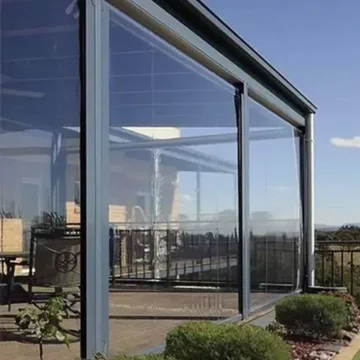
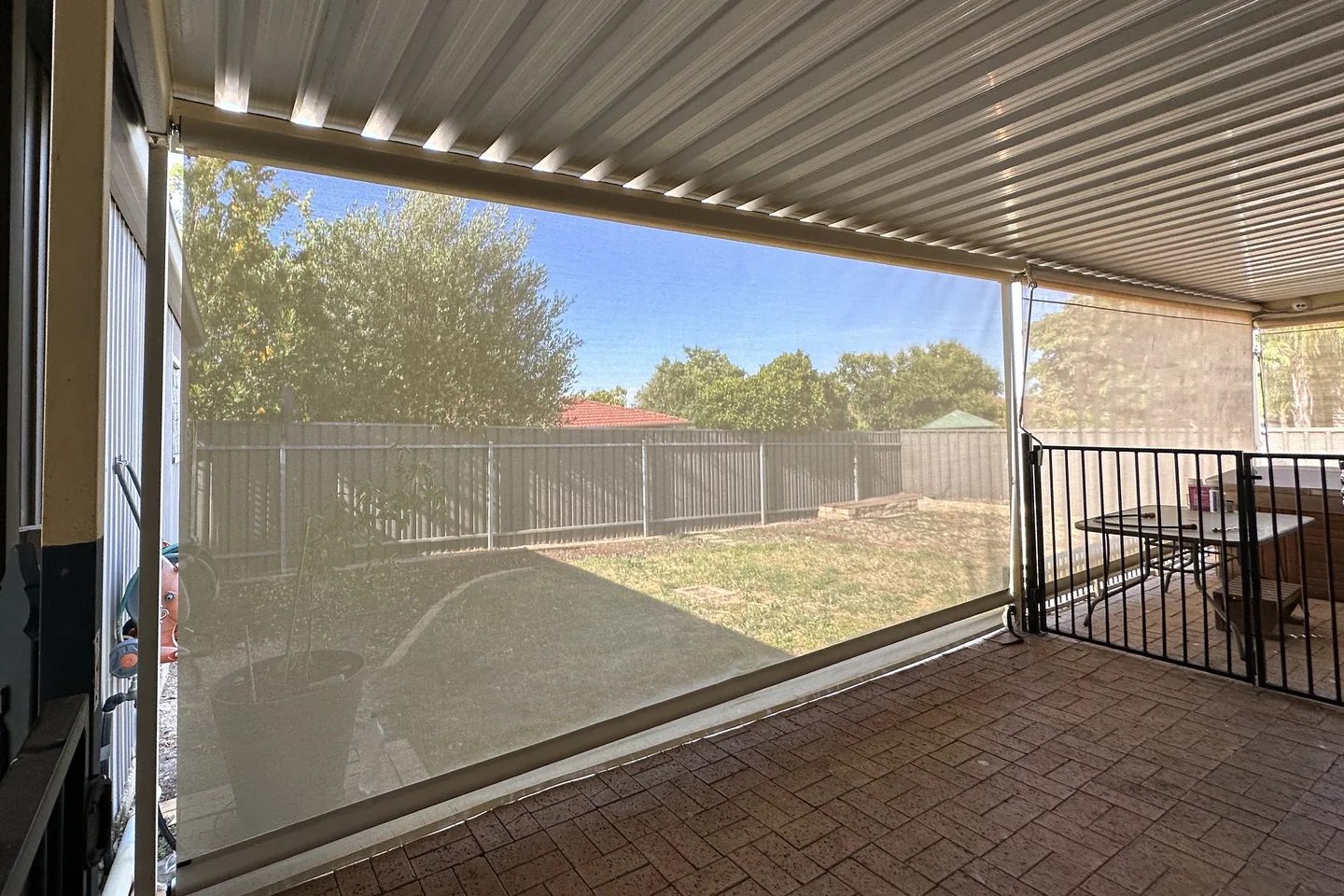
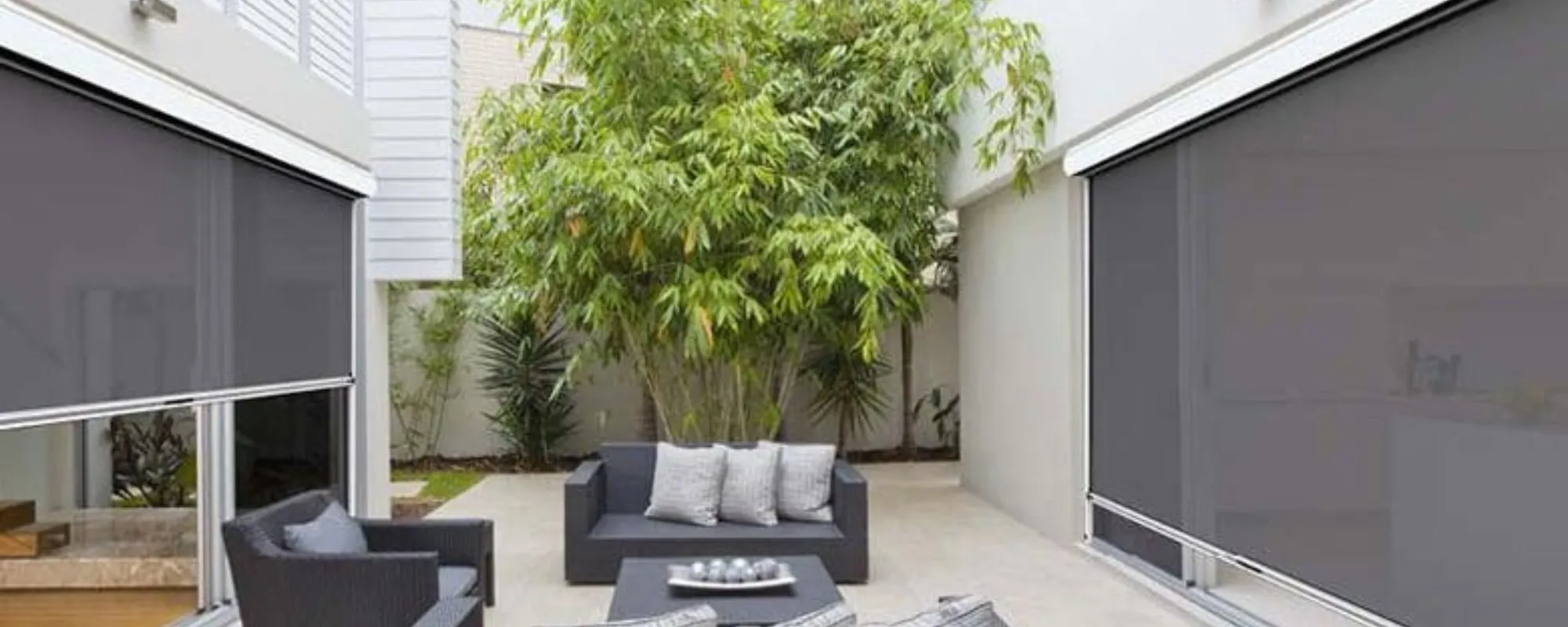
Unlike projecting awnings, straight-drop and side-guided outdoor blinds travel vertically in one flat plane from top to bottom. Their core job is to close off the vertical sides of an existing verandah, pergola or balcony—or drop flush down the outside face of an exposed west-facing window—to block low sun, cut glare and shelter outdoor furniture from cross-breezes.
- Channel-guided systems (Ziptrak® and Zipscreen): both roll vertically while retaining the fabric’s left and right edges inside slim aluminium side tracks—using a spline-in-track method on Ziptrak and a concealed zip-in-track (z-LOCK) guide on Zipscreen. Capturing the edges removes side light gaps and stops the blind flapping freely between posts. Our Ziptrak vs Zipscreen comparison walks through the hardware and operation differences.
- Traditional Straight Drop blinds: roll vertically from a top aluminium tube to a fabric-pocketed bottom bar with free side edges (no tracks or zips), secured at the post or paving using straps, dog clips and small S3 saddle loops. Available in spring assist, crank gearbox, cord and pulley, or motorised options up to 5.8 m wide.
- Veue Wire-Guided straight drop blinds: replace side straps and solid side channels with two tensioned stainless-steel cables running vertically from the headbox to floor or face terminals. They give a cleaner look where side channels cannot be mounted, though wires naturally allow more movement and noise in gusty weather than full side tracks.
- Cafe / Zip Roll Up blinds and Fixed Infill panels: traditional bottom-rolling or zippered verandah blinds suited to patio bays and hospitality areas, alongside custom fixed fabric panels made to close triangular gable ends or angled verandah corners.
If you are weighing up a vertical verandah screen against a projecting window awning on your own home, our companion guide on outdoor blinds versus canvas awnings explains how to map both to where sunlight enters your rooms.
Why the industry now calls them “Outdoor Blinds”—and what is NOT included
To make life simpler for customers, most of the Australian blind industry now groups all fabric exterior shading products—whether straight-drop verandah blinds or angled window awnings—under the umbrella term “outdoor blinds”. When homeowners start searching for west-facing heat relief, grouping fabric options together avoids forcing anyone to guess trade mechanism names before speaking with a consultant.
However, two very common exterior window and patio products sit outside the fabric outdoor blind family—and callers frequently confuse the names of those two with each other as well:
1. External aluminium plantation shutters are NOT outdoor blinds (and NOT roller shutters)
Rigid outdoor plantation shutters—often called external shutters or aluminium shutters on the phone—are built from heavy-duty powder-coated aluminium frames filled with adjustable or fixed elliptical louvre blades (60 mm, 90 mm or 115 mm). Panels can be hinged, sliding, bi-folding across a large patio opening, or fixed in place. Unlike fabric blinds that roll up into a tube, louvred shutters stay in the opening and pivot their blades through up to 180 degrees to direct breeze, sun and privacy like an outdoor Venetian architectural screen.
2. Aluminium roller shutters are a security and window insulation barrier
Aluminium roller shutters (such as our Ozroll Rollashield AR400 series) consist of interlocking, curved foam-filled aluminium slats running in fixed side channels and rolling into a compact headbox right above a house window or external door. While people occasionally call them “outside blinds” or “external shutters”, roller shutters are primarily a security deterrent, total window darkening and thermal/acoustic insulation barrier—completely different in construction and purpose from fabric outdoor blinds or louvred plantation shutters.
Fabric guide: Mesh, Acrylic, Poly-Cotton Canvas and 100% Blockout
Here is where the biggest shift has happened over the past decade. Traditionally, awnings were almost always made in blockout fabric—most famously classic greenback canvas—while straight-drop blinds were canvas or clear PVC. Today, outdoor blinds whether straight-drop or awning-style share the same modern outdoor fabric families:
| Fabric type | Vision through | Light underneath | Night privacy | Commonly paired products |
|---|---|---|---|---|
| 95% / 99% woven mesh (5% or 1% openness, e.g. Outlook Mode / Privacy, Skyline) | Slight to good daytime outward view; darker colours look clearest | Filters glare while keeping soft daylight and airflow | Not private at night when indoor or patio lights are on | Ziptrak®, Zipscreen, Straight Drop, Wire Guide, plus modern Auto Guide & Pivot Arm awnings |
| Solution-dyed acrylic (e.g. Docril, Dickson / Planosol) | No vision through (woven opaque textile) | Allows soft, diffused natural glow without feeling heavy or dark | High privacy (no silhouettes or clear view through) | Most common in Folding Arm awnings; also used on window awnings & straight drops |
| Poly-cotton canvas (traditionally greenback canvas, e.g. Somerton, Brella) | No vision through (solid blockout weave) | Full shade/blockout underneath; underside backing reduces reflected glare | Full blockout privacy day and night | Classic Auto Guide, Pivot Arm and Straight Drop awnings |
| 100% blockout ‘mesh-style’ (0% openness / solid PVC-coated outdoor cloth) | No vision through | Complete blockout through the fabric sheet | Full privacy day and night | Straight-drop, Zipscreen/Ziptrak, Auto Guide and Pivot Arm systems wanting modern clean blockout |
| Clear or tinted Cafe PVC | Clear glass-like view (with natural vinyl reflections/waviness) | Full daylight | No privacy | Vertical Ziptrak® or Zip Roll Up verandah blinds only (not window awnings) |
95% and 99% outdoor mesh (daytime vision and airflow)
PVC-coated woven polyester mesh—such as Ricky Richards Outlook Mode (95% shade / 5% openness) and Outlook Privacy (99% shade / 1% openness)—is the most common choice across modern vertical blinds and is increasingly popular on Auto Guide and Pivot Arm window awnings too.
Three practical things we always point out at a free measure:
- Night-time lighting flips privacy: mesh offers one-way daytime privacy when it is brighter outside than inside, but people outside can see in at night once interior or patio lights are switched on.
- Colour changes clarity: darker charcoal and black weaves absorb reflected glare so you see out into the garden more sharply; pale cream or sand meshes look lighter from the street but diffuse more light and wash out the outward view.
- Standard 3.2 m roll width: because most outdoor mesh rolls are 3.2 metres wide, blinds with a finished drop over 3.2 metres require a high-frequency welded horizontal join placed near the top roller out of your main eyeline (which we point out clearly at quote stage).
Solution-dyed acrylic fabric (soft light without vision through)
Many homeowners want shade over a glass living-room slider or outdoor terrace without turning the room behind it into a cave. Solution-dyed acrylic (such as Docril or Dickson / Planosol) solves that problem: its woven textile lets gentle natural daylight filter through for an airy feel, while giving zero see-through vision from outside.
Because solution-dyed acrylic is lightweight, colourfast, breathable and mould-resistant without sagging over time, it is the signature fabric for Folding Arm awnings—and an underrated choice for window awnings when you want soft brightness without anyone looking straight back inside.
Poly-cotton canvas (traditional greenback canvas) & 100% blockout
Traditionally, Adelaide window awnings were built almost exclusively in blockout poly-cotton canvas—most recognisably the classic heritage greenback canvas (with a protective green or neutral glare-reducing underside from long-standing Australian weavers such as Somerton and Brella). Canvas still looks right at home on character stone villas, Federation bungalows and brick veneer homes across Adelaide.
If you love the total blockout and night-time privacy of traditional canvas—with zero light penetration and zero view-through—but prefer the sleek solid-colour look and welded seams of contemporary architectural homes, 100% blockout ‘mesh-style’ (0% openness / solid PVC-coated) outdoor fabrics deliver the same complete blockout performance across both straight-drop blinds and modern window awnings.
For homeowners considering transparent wind-and-rain screening on a covered verandah rather than shade, read our honest breakdown of clear PVC versus mesh outdoor blinds before ordering—and remember that clear PVC should never be left rolled up baking in direct summer sun.
Which option suits your Adelaide home?
- You want to stop western sun hitting an external house window while still opening the window behind it: start with an angled Auto Guide awning or Pivot Arm awning in traditional blockout canvas, 100% blockout, acrylic or 95%/99% mesh.
- You want overhead shade across an unroofed deck or patio with no posts: compare a retractable Folding Arm awning in solution-dyed acrylic (or a Sundream conservatory awning where a pergola frame already exists).
- You want to enclose the open side of a covered verandah or alfresco: compare straight-drop Ziptrak®, Zipscreen, traditional Straight Drop or Veue Wire-Guided outdoor blinds.
- You want rigid louvred screening or window security: look at Outdoor Aluminium Plantation Shutters for louvred panels or Ozroll Roller Shutters for security, bedroom blackout and window insulation.
No fabric blind or retractable awning is a permanent roof or cyclone shelter. Always retract awnings and follow wind limits in severe Adelaide weather, avoid rolling canvas or mesh up soaking wet so moisture cannot cause mould, and ask for 316-grade stainless-steel components if you live near the coast.
Frequently asked questions
Are outdoor blinds and awnings the same thing?
Traditionally, no: an awning projects out on an angle (like an Auto Guide, Pivot Arm or Folding Arm awning), while an outdoor blind or straight drop blind travels straight up and down vertically across an opening. Today, most of the blind industry uses outdoor blinds as a broader umbrella term covering both, so telling your consultant where the shade needs to sit—over a window, overhead with no posts, or enclosing a verandah side—matters more than which word you use.
What is the difference between external aluminium shutters and roller shutters?
External aluminium plantation shutters (also called external shutters or aluminium shutters) are rigid hinged, sliding, bi-fold or fixed frames with adjustable louvre blades you tilt for airflow, shade and privacy around an alfresco or window. Aluminium roller shutters are interlocking foam-filled aluminium slats that travel in fixed side channels and roll into a headbox directly over a window or door for physical security, total light block and insulation.
Should I choose 95% mesh, 99% mesh, acrylic or blockout canvas?
Choose 95% or 99% woven mesh when you want shade, breeze and daytime view out (noting mesh is not private at night when lights are on inside). Choose solution-dyed acrylic when you want soft filtered daylight with complete visual privacy—especially on folding arm awnings. Choose traditional poly-cotton greenback canvas or a 100% blockout 0% openness fabric when you want maximum heat and glare blocking with zero view-through day or night.
Can you put mesh on a window awning, or blockout fabric on a straight-drop blind?
Yes. Modern Auto Guide and Pivot Arm awnings are regularly made in 95% or 99% Outlook Mode/Privacy mesh for homeowners who want to keep their view out to the street or garden, while Ziptrak®, Zipscreen and traditional straight-drop blinds can be made in 100% blockout or heavy canvas where night-time privacy or full sun block is needed.
Can an older canvas awning or outdoor blind be re-clothed or repaired?
Often, yes—provided the existing roller tube, tracks, brackets and arms are in sound condition. Visit our repairs and maintenance page or storm and track-blind repair guide, or drop into our Campbelltown showroom at 5/511 Lower North East Road to compare fabric swatches side by side. Ready to compare options in your own outdoor light? Request a free in-home measure and quote so we can help your household Live Comfortably.